The Foundation You're Ignoring: Why Ankle Strength and Deep Core Work Matter More Than You Think

Hi, I’m Jessica,
I’m a certified 500H Yoga Teacher specialized in flexibility & strength trainings and a Yoga practitioner for 14+ years
I’m not a dancer.
I’m not an ex-athlete.
I wasn’t a “naturally flexible” kid.
I built my movement after 40, through trial, error, and the realization that traditional training wasn’t cutting it.
I created a method that bridges the gap between strength and flexibility—without the fluff, without wasting time, and without forcing movements that don’t feel right:
FLEX&FLOW® a new way of movement.
If your goal is a strong, resilient core that actually supports your movement by the end of 2026, start training your TVA now.
I know, what even is a TVA?
Your TVA, or transversus abdominis, is your deepest core muscle, your inner corset. And it is not flashy at all.
It won't make your abs pop. It won't look cool on Instagram. The cue is simple: pull your belly button back toward your spine.
But here is the thing, for most of us it is way harder than it looks. We rarely use it. We're not used to activating it. Just getting that subtle engagement going is already a win.
This week I am focusing on two things that don't get nearly enough attention: my TVA and my ankles. Not the sexiest topics. Not trending on social media. But foundational to everything your body does.
Let me explain why these matter, and why ignoring them might be the missing piece in your training.
The Deep Core Muscle Nobody Talks About
Training your TVA is not about sweating, showing off, or fancy moves. It is about training the deep core, the muscles that actually stabilize you.
Most people think of core training as crunches, planks, or visible abs. But your TVA sits deeper than that. It wraps around your midsection like a natural weight belt, connecting your ribcage to your pelvis. When it engages properly, it creates internal pressure that stabilizes your spine from the inside out.
The problem? Modern life doesn't ask much of this muscle. We sit for hours. We move in limited ranges. We breathe shallowly. Our TVA falls asleep, and we don't even notice until something else starts hurting.
Why Bother Training Your TVA?
Because TVA activation gives you:
10 times more stability and core strength – When your deep core fires correctly, your entire torso becomes a stable platform for movement. Lifting feels easier. Balance improves. Your body can generate power without compromising your spine.
Support for your lower back – Most lower back pain stems from instability, not weakness. When your TVA is offline, your lower back muscles overwork to compensate. They tighten up. They ache. Training your TVA takes the pressure off.
A stable spine and smoother movement – Movement quality changes when your core is genuinely stable. You stop bracing with your breath. You stop gripping with your neck and shoulders. Everything flows better because your foundation is solid.
Small cue, big impact. Your core will actually work for you, not just look good.
How to Feel Your TVA Working
Try this right now:
Push your hands into something solid, a wall, a block, your desk. Keep your elbows wide. Pull your belly button back toward your spine, not up, not in, just back.
Notice what changes in your body. You might feel your ribcage settle. Your lower back might lengthen slightly. Your breath might shift. That subtle tension you feel deep in your abdomen? That is your TVA waking up.
It doesn't feel like much at first. That is the point. Deep stabilization is not dramatic. It is precise. It is quiet. It is the difference between training muscles and training movement.
The Other Foundation You're Ignoring: Your Ankles
This week I am also doing something simple: focusing on my ankles.
Not sexy. Not trending. Just ankles.
But our ankles are literally the foundation for almost every movement we make, and most of us completely ignore them until something hurts.
Think about it. Every time you walk, run, squat, lunge, or stand on one leg, your ankles are the first point of contact with the ground. They absorb force. They adjust to uneven surfaces. They stabilize your entire body from the bottom up.
Weak ankles mess with your balance, your stability, and how your entire body moves from the ground up. When your ankles aren't doing their job, everything else has to compensate, your knees, your hips, your lower back.
What Happens When Ankles Are Weak
I see this constantly. Someone comes to class with knee pain. We look at their squat. Their knees cave in. But the issue isn't actually their knees, it is their ankles collapsing inward because they lack the strength to maintain alignment.
Or someone struggles with balance in single-leg exercises. They wobble. They grip their toes. They tense their entire leg trying to stay upright. But again, the issue is not balance in general, it is that their ankle stabilizers are not firing.
Weak or immobile ankles create a cascade of compensation:
Your knees move incorrectly to make up for limited ankle range
Your hips work overtime to stabilize what your ankles should be controlling
Your lower back tightens because your foundation is unstable
Your posture shifts forward because your ankles can't support proper alignment
All of this from ankles that just aren't strong or mobile enough.
Small Habits, Big Shifts
So this week I am spending a few minutes each day on small, consistent exercises to wake up the deep stabilizing muscles in my feet and ankles. Not hours, just minutes. Building strength, improving mobility, making everything from walking to squatting feel more controlled.
That is the whole point of these tiny habits. They stack up.
You don't need to spend an hour on ankle work. You need consistency. A few minutes every day, activating the small muscles in your feet, moving your ankle through its full range, building strength in positions that challenge stability.
Strong, flexible ankles support your knees, hips, and spine. They help your body move more efficiently and reduce stress on your joints. Small daily movement, big long-term impact.
When your ankles are strong and mobile, everything upstream works better. Your squat deepens. Your balance improves. Your knees stop complaining. Your hips move more freely. Your body feels more capable.
The Gap in How We Train
This brings me to something I keep hearing from so many of you:
"I do all the things, gym, Pilates, stretching, running, but my hips still feel off."
"My shoulders get tired too quickly."
"My knees complain every time I move."
"My lower back is quietly plotting against me."
"My balance disappears when I try something simple."
"That tightness versus strength battle never ends."
"My body just doesn't feel capable like it should."
It's not a lack of effort. You are putting in the work. You are showing up. You are trying.
It's a gap in how we're training.
Most fitness approaches separate strength and mobility. You lift weights to get strong. You stretch or do yoga to stay mobile. You run for cardio. You do Pilates for core. Everything is piecemeal. Everything is separate.
But your body doesn't work in pieces. Your body works as a system.
When you squat, you need hip mobility and hip strength at the same time. When you reach overhead, you need shoulder mobility and shoulder stability together. When you balance on one leg, you need ankle strength and ankle range simultaneously.
Separating these qualities in training means they don't integrate in movement. You end up strong but stiff. Or mobile but unstable. Your body never learns to be both at once.
This Is Why FLEX&FLOW® Exists
FLEX&FLOW® is not another thing to add to your routine. It's the thing that makes everything else actually work.
We train your muscles to move with strength and your joints to move with freedom, so your body finally feels capable in every position.
Every exercise in FLEX&FLOW® asks your body to be strong and mobile at the same time. We don't separate the qualities. We integrate them. Because that is how your body actually needs to function.
When you master deep stabilizing strength instead of chasing the burn, movement becomes precise. Power feels contained. Your body works as a system.
That's the difference between training muscles and training movement.
Real Talk From People Doing the Work
One client, D., told me after class this week that for years she struggled with pain and weakness in her extensor tendons. She lifts weights too, so this wasn't about lack of strength. For two years now? Gone. It disappeared when she started FLEX&FLOW® two years ago. The muscles in her feet became so strong.
Another client, N., saw her physiotherapist the day before and guess what they worked on? Exactly what we covered in class: ankle strength and mobility.
From the community:
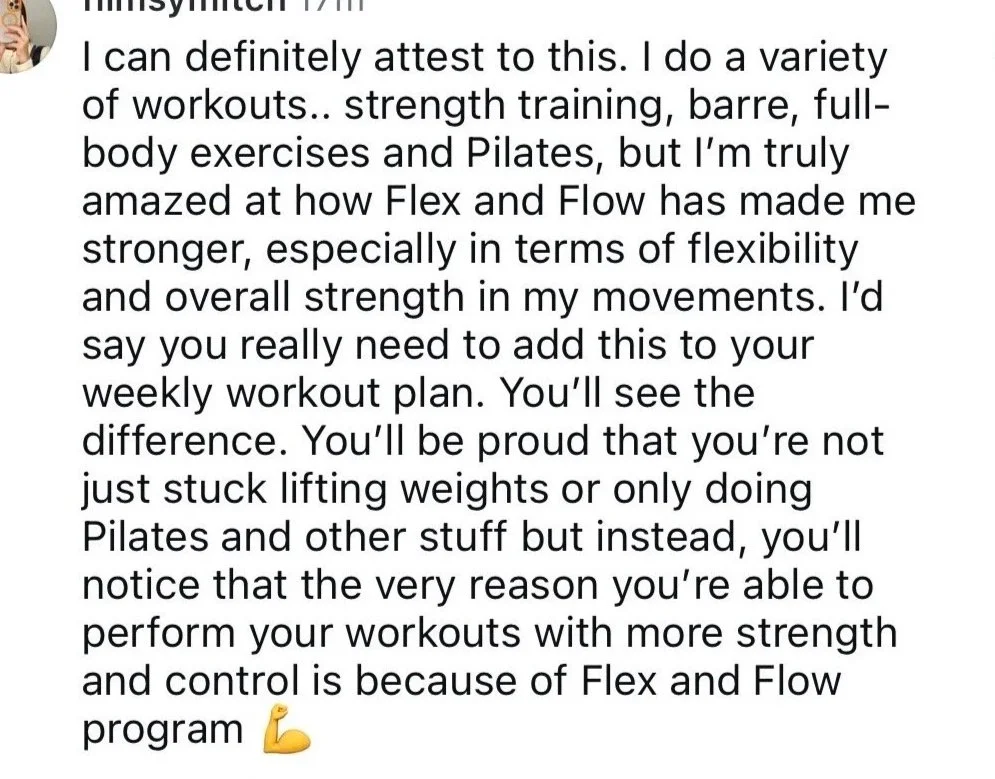
These are not isolated stories. This is what happens when you stop training body parts and start training movement patterns. This is what happens when strength and mobility work together instead of against each other.
Your Body Is Supposed to Feel Capable
Strong. Resilient. Not just in the gym, but in life.
You should be able to squat down to pick something up without your knees complaining. You should be able to reach overhead without your shoulders hiking up. You should be able to stand on one leg without wobbling. You should be able to move through your day without constant tightness, compensation, or that nagging feeling that something is off.
If you're ready to stop piecing together random workouts and start moving like your body was designed to move, you know where to find me.
Start Small, Start Now
The truth is, small daily habits like this stack up.
Try that TVA cue this week. Push your hands into something solid, a wall, a block, your desk. Keep your elbows wide. Pull your belly button back toward your spine. Notice what changes in your body. That is your deep core waking up.
Spend a few minutes on your ankles. Roll through your feet. Stand on one leg. Move your ankle in circles. Challenge your balance. Wake up those stabilizers.
These tiny habits will not transform your body overnight. But they will compound. Day by day. Week by week. Small cue, big impact.
Your body is waiting for you to pay attention to the foundations. Your TVA. Your ankles. The deep, unsexy, unglamorous work that changes everything.
Start now. Your body will thank you by the end of 2026.
Sometimes You Need More Than a Few Minutes at Home
But sometimes, the body and mind need more than a few minutes at home. They need space to fully stretch, strengthen, and reset. That's exactly why we're gathering in March.
After months of winter, your body can feel tight, your energy may be slower, and your mind carries weight you might not notice until you step away. Before summer arrives, this is the perfect window to pause, recharge, and reconnect with yourself.
THE FLEX&FLOW® Retreat x Parkhotel Mondschein
26 to 29 March 2026, Bolzano
Wake up supported. Wake up lengthened. Wake up strong.
This retreat is your chance to immerse yourself in movement that stays with you long after you return home. Give yourself the gift of FLEX&FLOW® — time, space, and guidance to reconnect with your body, your energy, and your movement.

Your body is supposed to feel capable. Strong. Resilient. Not just in the gym, but in life.
Keep moving,
Jessica
Ready to experience the FLEX&FLOW® difference? Visit JESSICA KLIMACH FLEX&FLOW® SCULPTED STRENGTH & FLUID MOBILITY THE REVOLUTIONARY ALL-IN-ONE METHOD trust me, your body has never felt this good to learn more about my strength and mobility training programs. Your body has been waiting for this conversation.